How Sourcing From a Rubber Timing Belt Factory in China Has Changed for Buyers Who Know What to Verify
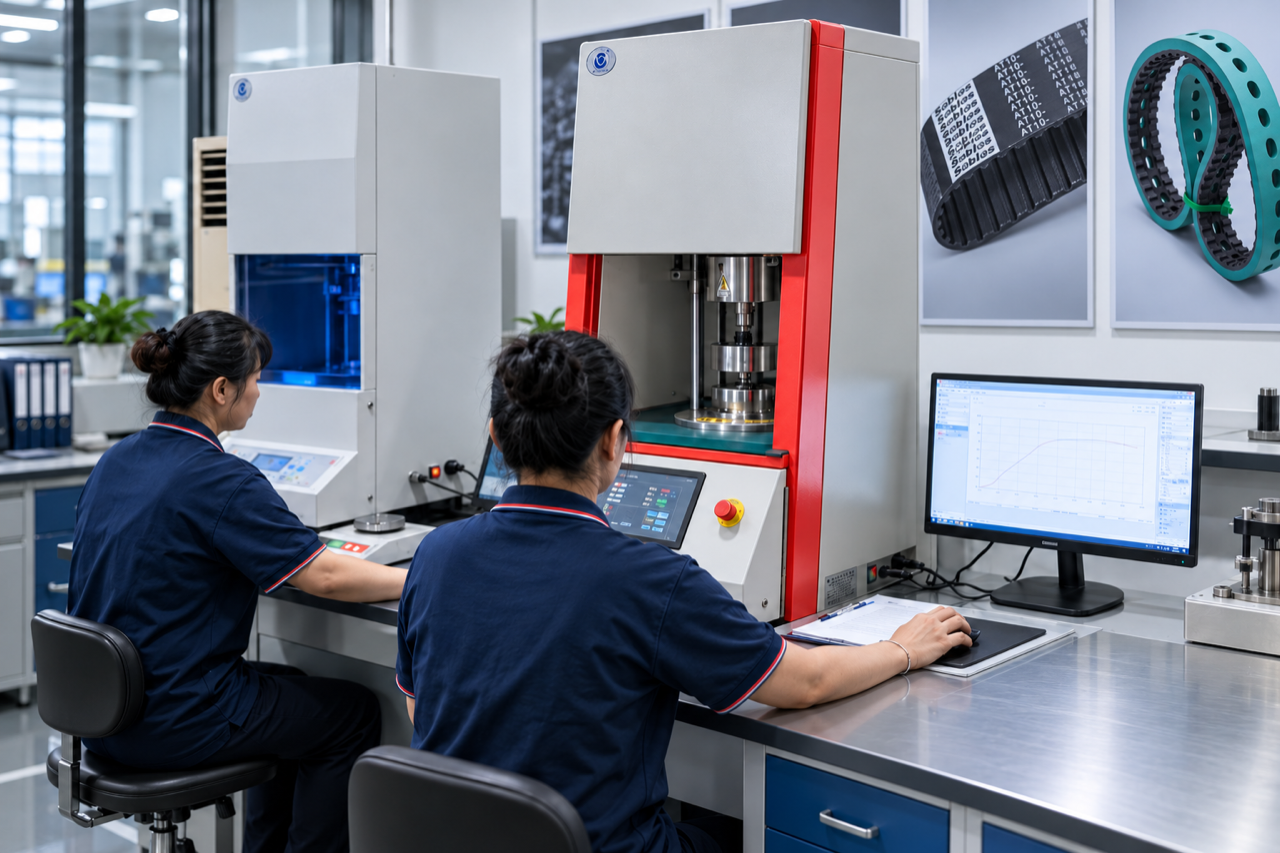
The conversation about sourcing timing belts from China has shifted in the past decade. Early-stage buyers who entered the market expecting uniform quality across suppliers and discovered the variance the hard way have been replaced, in many categories, by buyers who’ve learned what to verify and who to work with. The factories that have survived and grown are not the same as the factories that were shipping product ten years ago, and the evaluation process that worked then — or didn’t — isn’t the right model for the current market.
What Has Actually Changed
The bottom of the China timing belt market still exists. There are factories producing belts at price points that reflect corners cut in compound quality, cord specification, and dimensional control. That hasn’t changed. What has changed is that the top tier of Chinese rubber timing belt manufacturing has moved significantly closer to international standards in process capability, material sourcing, and quality documentation.
Factories that invested in German and Japanese mixing and extrusion equipment in the early 2010s are now running mature processes with process capability data that holds up to external scrutiny. Their raw material sourcing has stabilized around suppliers with documented specifications — cord from established suppliers with consistent twist angle and adhesion treatment, compound from in-house or long-term contract mixing rather than spot market purchases. Their quality systems produce documentation that a European or North American OEM buyer can review and audit.
The gap between this tier and the lower tier has widened rather than narrowed, which makes supplier selection more consequential than it was when the spread was smaller. A buyer who selects on price alone has a higher probability of landing in the lower tier than a buyer who selects based on verified process capability.
The Verification Steps That Separate Tiers
Buyers who source effectively from Chinese rubber timing belt factories have largely converged on a consistent verification approach. The steps are not complicated, but they require asking for specific things rather than accepting general assurances.
The first step is requesting pitch and tooth height measurements from production samples, reported as a distribution rather than as a single value. A factory running capable processes will have this data because they collect it as part of production control. The distribution — mean, standard deviation, and the percentage of product within tolerance — tells you more than a “yes we meet ISO 9001” statement. A factory that can provide this data on short notice is collecting it continuously; one that needs time to produce it is measuring after the fact rather than in-process.
The second step is asking about compound sourcing. Specifically: who makes the rubber compound, what is the specification on hardness and tensile strength at delivery, and what is the acceptance procedure if a batch is out of specification? A factory that answers this with specifics — named supplier, documented spec, documented incoming inspection procedure — is operating differently from one whose answer amounts to “we use quality rubber.”
The third step is auditing the tensile cord lay-up, either directly or through a third-party lab measurement of cord spacing and angle consistency across a belt sample. Cord placement consistency is the variable most directly linked to pitch accuracy under dynamic load, and it’s the variable most often sacrificed when a factory reduces costs. A pitch-accurate belt that develops pitch error after a few hundred hours of high-cycle operation typically has inconsistent cord lay-up — the cords have shifted under load because the adhesion or placement wasn’t controlled tightly enough.
How the Commercial Relationship Affects Quality
Chinese factories that supply into demanding international markets have learned that the quality of the commercial relationship affects the quality of the product. A buyer who sends a clear technical specification, visits the factory or sends an auditor, establishes a clear incoming inspection protocol, and provides feedback on field performance gets better product than a buyer who sends a drawing and a target price and waits for samples.
This isn’t because the factory is deliberately producing worse product for less engaged buyers — it’s because the specification gaps that produce field problems are more likely to be caught and corrected when the buyer is engaged enough to create feedback loops. A buyer who never inspects incoming product and never reports field problems gives the factory no information to act on, and the product drifts toward whatever is easiest to produce rather than whatever the application requires.
The factories that now supply into automotive Tier 1 and industrial OEM programs in Europe and North America have this feedback loop in place. They receive clear specifications, they’re audited against them, and they’re held accountable for out-of-specification production. That accountability has driven process improvements that benefit all the customers receiving product from the same production line.
What Remains True About the Lower End
None of the above means that every Chinese rubber timing belt factory has improved. The lower end of the market continues to produce product that fails in high-cycle applications at rates that make the cost savings illusory — a belt that costs 40% less but lasts 30% as long while also causing downtime during replacement isn’t a savings. Buyers who select on price without verification continue to discover this.
The practical implication for a buyer entering the China market for timing belts is that verification is not optional. The market is heterogeneous enough that price is almost uncorrelated with quality across the full range of suppliers. Within the qualified tier, price differences reflect genuine cost differences and are worth negotiating. Below the qualified tier, price differences reflect specification shortcuts that show up as field problems.
Working with a rubber timing belt factory in China that can demonstrate process capability through actual production data — not just certifications — is the starting point for a supply relationship that delivers on the cost advantage of China sourcing without the downside risk of the lower-tier market. That demonstration is more available now than it was a decade ago, which is what has actually changed about this market for buyers who know where to look.